There are an estimated 258 million speakers of Russian in the world. The Russian language is spoken today in numerous countries, either as the official language or a recognized minority language. In addition to being the official language of the Russian Federation, Russian is an official language in Belarus, Kyrgyzstan, and Kazakhstan.
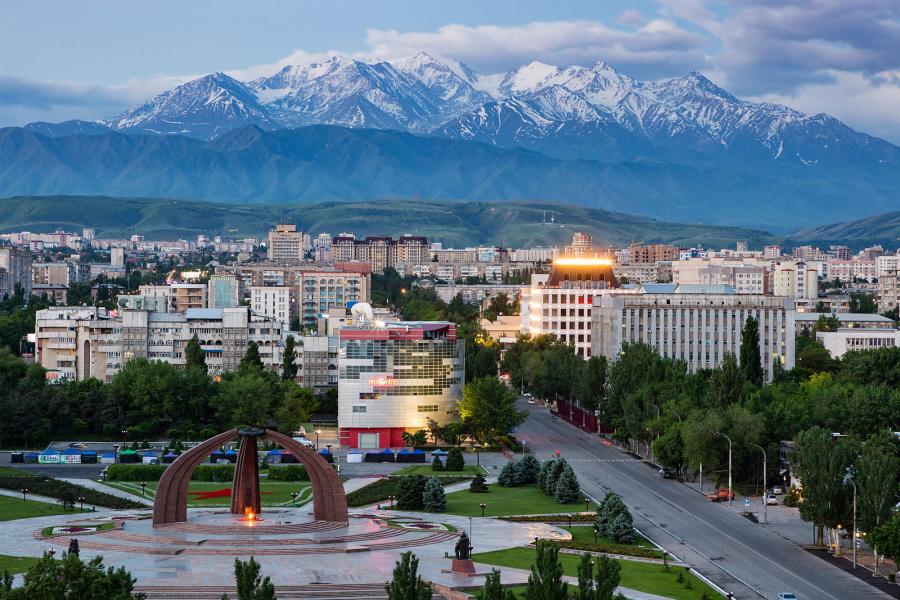
The Russian language is the lingua franca in many former Soviet republics (FSU), including:
- Ukraine: Although Ukrainian is the official language, Russian is a widely spoken minority language.
- Central Asia: Russian is the recognized language of inter-ethnic communication in Tajikistan, Turkmenistan, and Uzbekistan.
- Baltic States: While Russian is not an official language in Estonia, Latvia, and Lithuania, it's still spoken by a significant part of the population, especially by older generations.
- The Caucasus Region: Russian is utilized to varying degrees in Armenia, Azerbaijan, and Georgia, despite not having official status

Russian is also spoken in other countries around the world due to historical immigration patterns and modern political/economic reasons, including:
- Western and Central Europe: Germany has a large Russian-speaking population, the second largest in Europe outside of Russia. Russian is either spoken or widely understood in Poland, Moldova, Czechia, Slovakia, Hungary, and Bulgaria.
- United States, Canada, Australia: A significant number of Russian speakers reside in the United States, Canada, and Australia, particularly in major urban areas.
Why Study the Russian Language?
Russian holds an important role in international communication, serving as one of the six official languages of the United Nations. It's also one of two official languages used aboard the International Space Station.
Critical Language Designation
The U.S. government recognizes Russian as a critical language, meaning that there is a high demand for skilled speakers in various sectors. Russian is one of three critical languages (with Arabic and Chinese) chosen by the US government for its National Strategic Language Initiative, with a wide variety of career opportunities and opportunities for government-funded development, such as the Critical Language Scholarship.
High Demand
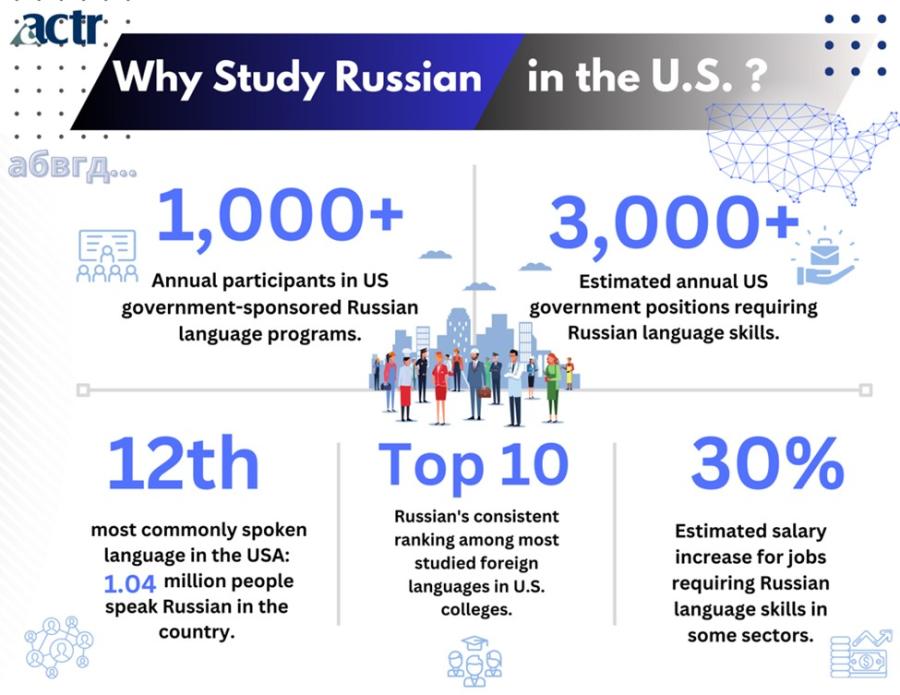
Russian speakers are sought after by employers in fields like government, national security, international relations, law, and business. There are more than 3,000 estimated annual US government positions that require Russian language skills
Salary Potential
Jobs requiring Russian language skills often come with a higher salary than those without such skills. There is a 30% estimated salary increase for jobs requiring Russian language skills in some sectors.
Studying Russian Pairs Well with
Anthropology
Russia is home to many diverse ethnic groups, peoples, and societies. Studying Russian alongside with Indigenous anthropology helps us understand the complex social and cultural dynamics within Russia, particularly concerning its many indigenous communities. Indigenous communities in Russia, like those in Siberia, are navigating ongoing social and economic changes that impact their health, demographics, and cultural practices. Anthropology helps study these challenges and how communities are adapting. Studying Russian language could allow you to engage directly with Indigenous Siberian and Central Asian communities within Russia and gain firsthand knowledge of their cultures and experiences, while indigenous anthropology would provide the theoretical framework and research methods to conduct culturally sensitive and ethical research.

Art, Film, Linguistics Studies and Literature
Russian literature, music, film, and art have made significant contributions to global culture. Russian language skills enable deeper understanding of Indo-European languages, their histories, structures, and writing systems.

Business
Studying Russian alongside a business major enhances global career prospects, especially in fields like energy, technology, and finance. Russian is a critical language for navigating not only the Russian economy, but also the economies of the former Soviet Union (FSU), which include Armenia, Azerbaijan, Georgia, Kazakhstan, Kyrgyzstan, Turkmenistan, Tajikistan, Estonia, Latvia, Lithuania, Belarus, and Ukraine. Knowledge of the Russian language, culture, and business etiquette can improve communication and build stronger relationships with Russian-speaking partners. Russian language proficiency can distinguish you from other job candidates, particularly in fields like international business, government, and non-profit sectors. Russian language skills can be beneficial in various business roles, such as financial, policy, and data analysts, market researchers, and consultants.

Environmental Studies
Environmental issues and policies that affect not only Russia itself, but the rest of the world are at the heart of combating climate change. We are at the point where it is impossible to think of solving global environmental issues and implementing policies for positive change and reversal of climate change without understanding Russia’s environmental approach. Studying Russian language, culture, history, politics will help us better incorporate this key player into global initiatives going forward.
Climate change will shape the future of Russia, and vice versa, regardless of who rules in the Kremlin. The world's largest country is warming faster than Earth as a whole, occupies more than half the Arctic Ocean coastline, and is waging a carbon-intensive war while increasingly isolated from the international community and its efforts to reduce greenhouse gas emissions. Officially, the Russian government argues that, as a major exporter of hydrocarbons, Russia benefits from maintaining global reliance on fossil fuels and from climate change itself, because warming may increase the extent and quality of its arable land, open anew year-round Arctic Sea route, and make its harsh climate more livable. Drawing on the collective expertise of a large group of Russia-focused social scientists and a comprehensive literature review, we challenge this narrative.
(Javeline, D., Orttung, R., Robertson, G., Arnold, R., Barnes, A., Henry, L., Holland, E., Omelicheva, M., Rutland, P., Schatz, E., Schenk, C., Semenov, A., Sperling, V., McIntosh Sundstrom, L., Troitskiy, M., Twigg, J., & Wengle, S. (2024). Russia in a changing climate. WIREs Climate Change, 15(2), e872. https://doi.org/10.1002/wcc.872)

History
Russian language skills enable deeper understanding of historical events and their impact on the world. Russian history is integral to understanding major world events, from the rise of the Russian Empire, and later the Soviet Union to the Cold War and beyond.
Russian equips students to interpret primary documents, many of which have not been translated into English.
Baylor University houses the Keston Archive for Religion, Politics, and Society and provides unique opportunities for undergraduate students to conduct archival research in both English and Russian, using archived letters, propaganda posters, and rare journals. Baylor’s Russian faculty are committed to undergraduate research.

International Studies, Media and Communication Studies, Political Science, and Pre-Law Studies
The Russian language is crucial for gaining insights into Eastern European and Central Asian geopolitics. Learning Russian allows for direct engagement with diverse cultures, including those in Russia, Belarus, Ukraine, and other countries where Russian is spoken: Georgia, Armenia, Azerbaijan, Kyrgyzstan, Kazakhstan, Turkmenistan, Tajikistan, Latvia, Estonia, and Lithuania. Studying Russian can open doors to careers in diplomacy, intelligence gathering, media literacy, and research involving Russia and its neighbors.
Studying Russian allows students to access original documents, media, and literature, providing unbiased primary sources for research and analysis. This ability to access media is especially important in understanding diverse perspectives on the war in Ukraine and Russia's global interactions.
Russian disinformation often leverages specific cultural and historical narratives to resonate with target audiences. Studying the Russian language and culture provides crucial context to understand these narratives, including historical revisionism and identity-related discourses. Research indicates that Russian propaganda exhibits distinctive linguistic features. Studying Russian language and linguistic patterns can help in identifying these features and understanding how language is used as a tool for disinformation. Analyzing emotionally charged language, recurring terms, and framing strategies can reveal the intended impact on audiences. Learning Russian allows for better discernment between official state propaganda and genuine expressions of Russian society, including critical and dissenting voices. This ability to distinguish between propaganda and dissenting voices is important for understanding the full spectrum of opinions and media landscapes in Russia.
Many Baylor Russian majors, secondary majors, and minors have gone on to law school or Russian and East European Studies masters programs and either work as attorneys or in government agencies—in the Department of State or the Department of Defense.

SEES--Slavic East European Studies
The Slavic and East European Studies program pairs organically with Russian language, as the two include several complementary courses and can share up to six hours across both majors. Slavic and East European Studies (SEES) area studies encourage students to develop integrated, wide-ranging, and connected understanding that enhances the study of Russian language, literature, culture, and linguistics. SEES students contextualize their Russian language study within a broader interdisciplinary and geographical context. The region encompasses historically Slavic areas and geographical territories known as the Soviet Union and the Eastern Bloc during much of the 20th Century--nations that today stretch from Central Europe northeast through the Baltic republics, southeast to Greece, Georgia and Armenia, and eastward through Belarus, Ukraine, Russia, Central Asia and Siberia to the Pacific Ocean. Those who wish to study Russian history, politics, or literature in translation should consider a SEES major or minor. Former Russian-SEES double majors are employed in diverse fields including military intelligence, medicine, law, and academia, among others.

STEM--Aviation, Chemistry, Computer Science, Engineering, Math, Neuroscience, Physics, and Pre-Health Studies
Russian is the second most important language for scientific publications after English, offering access to a wealth of research in various fields. It provides access to specialized knowledge in fields like science, technology, engineering, aviation, and mathematics, especially in areas where Russian expertise is significant.
All crew members of the International Space Station speak Russian, highlighting its importance in space exploration and collaboration.
Many students pursuing careers in health sciences have found Baylor’s Russian language program to be a strong complement to their STEM degrees, allowing them to get to know professors and classmates in small classes, pursuing independent studies in medical terminology, and equipping them to write Honors theses on Soviet vaccination campaigns, and HIV in the Soviet Union and in Russia.